Health and Safety Policy — Business Waste Removal Catford
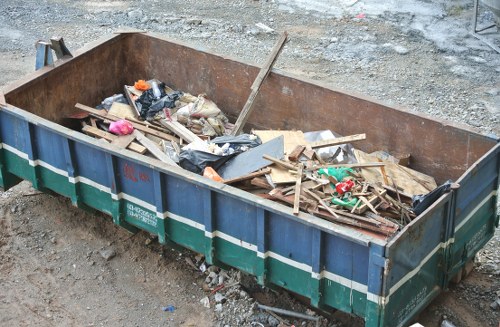 Policy statement: Business Waste Removal Catford is committed to protecting the health, safety and welfare of our employees, contractors and the public while delivering professional rubbish collection and commercial waste services. This policy sets out the responsibilities, standards and procedures that govern safe operation across our rubbish company service area. We endeavour to minimise risks through careful planning, training and monitoring, and to ensure compliance with applicable health and safety regulations without over-specifying local legal guidance.
The purpose of this document is to provide a clear framework for safe working during all stages of business waste handling including segregation, loading, transport and disposal. It applies to all staff engaged in commercial waste collection Catford and associated support functions. Managers will ensure resources and supervision are available, while employees must follow established routines and report hazards immediately. This policy emphasises practical controls that reduce the potential for injury, environmental harm and property damage.
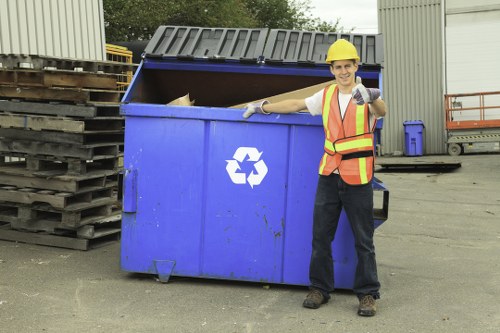 Scope and service coverage: Our routines encompass routine office waste removal, light construction debris, retail and hospitality refuse, and safe removal of non-hazardous commercial materials. We do not provide detailed specialist hazardous waste processing in this policy, but we do outline immediate segregation and notification procedures for potentially hazardous items. The guidance is suitable for a typical rubbish removal Catford operation and may be adapted for different types of business premises within the service area.
Responsibilities and organisational control
Senior management has overall responsibility for the implementation of this Health and Safety Policy and will ensure that risk assessments are completed and reviewed regularly. Line managers will maintain safe systems of work, provide necessary PPE and ensure vehicles and equipment are maintained to appropriate standards. Employees are required to follow instructions, use provided PPE and participate in safety training. Contractors and temporary staff must comply with our site rules prior to undertaking work. Business waste disposal in Catford must be conducted under supervised conditions when unfamiliar materials are encountered.
 Risk assessment and control measures: Risk assessments will identify hazards such as manual handling, slips, trips, vehicle movements, sharps and dust exposure. Controls include mechanical aids for lifting, segregation of waste streams, secure containment, clear site access and designated pedestrian routes. Vehicle-loading procedures will use step-by-step checklists to ensure loads are stable and covered where necessary. Routine audits will verify control measures are effective and that corrective actions are implemented promptly.
Training and competence are essential: staff will receive induction training, repeated refresher sessions and task-specific instruction for use of lifting equipment, compactors, and powered access devices. Training records will be maintained and monitored. Rubbish removal services are only to be performed by competent personnel and where necessary, under direct supervision until competency is demonstrated.
Operational procedures and emergency response
Safe working procedures cover vehicle operation, manual handling, waste segregation, spill response and dealing with unknown or potentially hazardous substances. Drivers must complete vehicle checks before and after shifts, follow permitted route and parking practices, and secure loads appropriately. Manual handling guidelines emphasise team lifts, correct lifting posture and the use of mechanical aids to prevent musculoskeletal injury.
 Spill and incident management: In the event of a spill, contamination or injury, staff must secure the area, assess the risk and follow established emergency procedures. Spill kits and first aid supplies will be available in depots and on vehicles. Incidents will be recorded and investigated to identify root causes and actions to prevent recurrence. Near-misses are reported and reviewed with the same rigour as accidents in order to promote continuous improvement.
 Monitoring, review and continuous improvement: The effectiveness of this policy is assured through regular inspections, performance metrics and management reviews. Audits will include vehicle and equipment inspections, staff competency checks, and verification of waste segregation records. Findings will inform training updates, operational changes and any necessary investment in equipment. The policy will be reviewed at least annually or after any significant incident, organisational change or regulatory update.
Personal protective equipment (PPE) and health measures: Appropriate PPE such as gloves, high-visibility clothing, safety boots and eye protection will be provided and must be worn where required. Respiratory protection will be supplied for dusty tasks or when handling materials that generate airborne contaminants. Health measures include provision of hand-washing facilities, occupational health access for medical concerns, and controls to minimise exposure to biological agents and sharps.
Waste segregation and documentation: Clear labelling, colour-coded containers and documented transfer notes ensure traceability and correct handling of different waste streams. Staff are trained to identify and segregate recyclable materials, general refuse and any suspected hazardous items. Where specialist disposal is required, the waste will be isolated and an appropriate waste contractor engaged according to regulatory requirements.
Review and acceptance: This Health and Safety Policy for commercial waste collection in Catford represents the organisation's commitment to managing health and safety risks associated with business waste removal. All personnel are required to read, understand and implement the policy. Management will provide the necessary support to ensure a safe working environment across the service area, balancing practical operational needs with a proactive safety culture.
